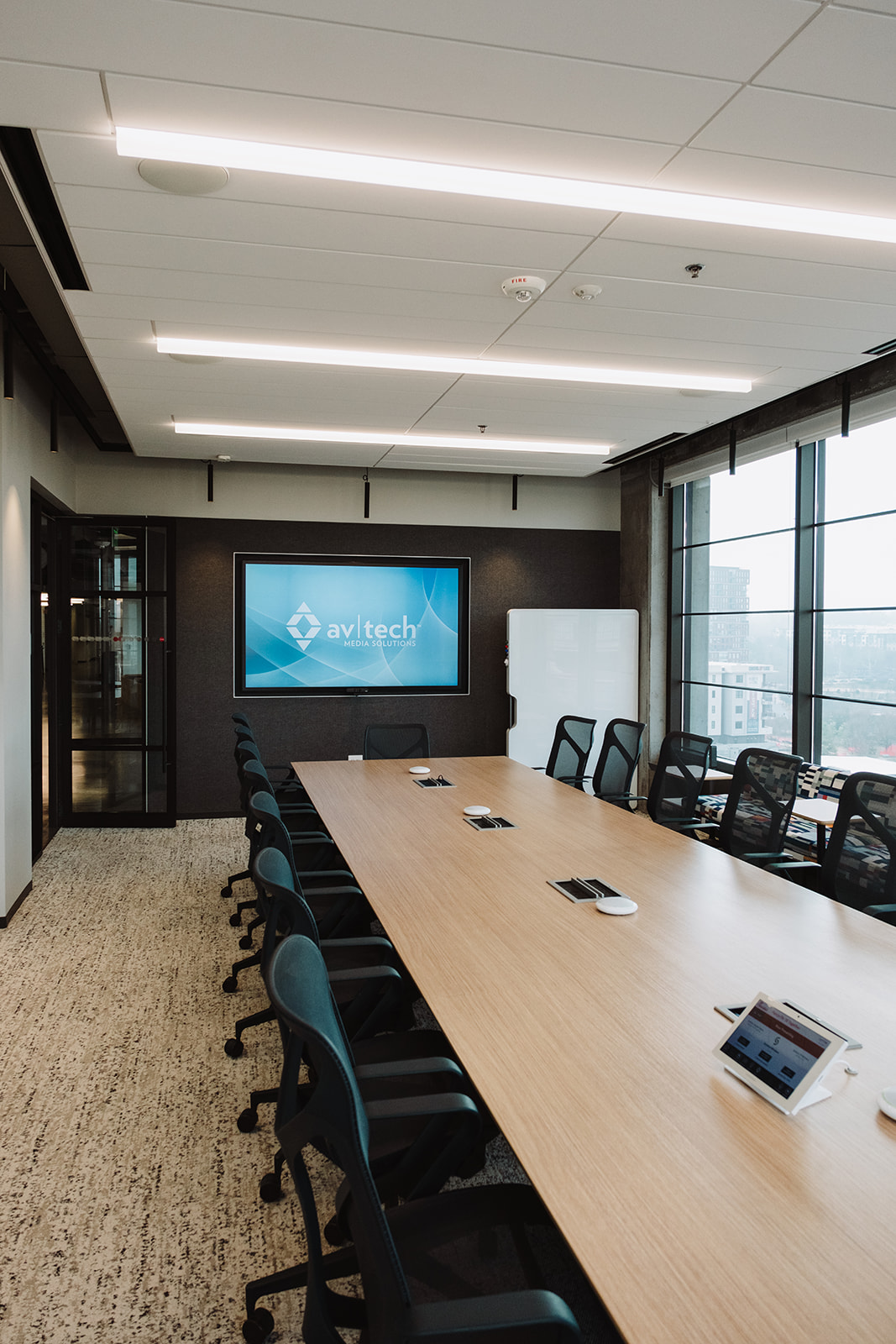

Enterprise headquarters concentrate risk, scale, and complexity in one environment.
When collaboration systems fail at a regional office, disruption is contained. When they fail at HQ, the impact ripples across executive operations, cross-functional coordination, and hybrid workforce performance. That’s why AV infrastructure planning must happen before room design — not after construction documents are finalized.
What Is Enterprise AV Infrastructure Planning?
Enterprise AV infrastructure planning defines how audiovisual systems are architected, scaled, secured, and governed across large organizations to support headquarters operations, hybrid work, and long-term business growth.
It typically includes:
- Capacity and scalability planning for enterprise environments
- Network, power, and security alignment with IT infrastructure
- Centralized control, monitoring, and management frameworks
- Governance, standards, and lifecycle planning across locations
Why AV Infrastructure Planning Matters at Enterprise HQs
In headquarters environments, AV infrastructure planning is an operational control decision.
Enterprise AV infrastructure underpins executive boardrooms, town halls, and hybrid collaboration spaces. If backbone architecture is fragmented or under-designed, instability becomes systemic.
Common risks include:
- Capacity limits that restrict growth
- Security gaps across unmanaged endpoints
- Monitoring blind spots
- Inconsistent performance in high-visibility spaces
Planning infrastructure early prevents rework, protects IT governance, and limits long-term technical debt.
AV Infrastructure vs AV Room Design
AV room design focuses on visible components: displays, cameras, microphones, and interfaces.
AV system planning defines backbone architecture: signal distribution, network segmentation, control standards, management layers, and scalability models.
When infrastructure is under-planned, room-level execution compensates with custom workarounds. Over time, those workarounds become complexity. Infrastructure should be defined through disciplined AV system design, with room design executing within established architectural guardrails.
Core Components of Enterprise AV Infrastructure
Enterprise AV infrastructure includes:
- Network architecture and segmentation
- Power planning and redundancy
- Signal distribution strategy
- Centralized control systems
- Monitoring and management platforms
- Integration with collaboration ecosystems
These components must be planned centrally to support IT-managed AV systems. Industry guidance from AVIXA consistently emphasizes standardized architectures and documentation in scalable environments.
Decentralized decisions increase variation. Centralized architecture reduces it.
Designing AV Infrastructure for Scale and Hybrid Work
Headquarters no longer serve only on-site employees. They anchor distributed teams. The result is that hybrid workplace AV infrastructure must support executive broadcasts, large-scale meetings, and evolving collaboration platforms. Scaling AV infrastructure requires capacity modeling and modular architecture — not provisioning for current occupancy alone.
AV Infrastructure Governance and Ownership
AV infrastructure governance defines standards, decision rights, and lifecycle accountability.
In enterprise environments, IT should lead infrastructure planning, coordinating with facilities and AV stakeholders. Applying IT service management principles such as ITIL embeds change control, monitoring, and lifecycle discipline into the platform.
Without governance, infrastructure drifts. With governance, performance stabilizes.
Common AV Infrastructure Planning Mistakes
Common AV infrastructure planning mistakes include:
- Underestimating long-term capacity
- Ignoring centralized monitoring
- Allowing siloed decision-making
- Planning for immediate demand instead of future scale
These mirror broader AV system design mistakes — but at infrastructure scale, the consequences are more disruptive.
How to Approach AV Infrastructure Planning for a New or Renovated HQ
Effective AV infrastructure planning for enterprises begins before equipment selection.
High-level steps include:
- Assessing infrastructure maturity and risk
- Aligning with enterprise-wide AV system design standards
- Coordinating IT, facilities, security, and AV stakeholders
- Defining lifecycle strategy and long-term roadmap
AV infrastructure decisions shape years of operational performance. Planning early reduces cost, risk, and disruption. At the HQ level, AV infrastructure is a strategic IT investment — not a facilities add-on.
Organizations formalizing this approach rely on structured AV system design standards to define architectural guardrails. A broader enterprise AV system design framework ensures infrastructure and room execution remain aligned. And where instability already exists, examining common AV system design mistakes can clarify where drift began.
Frequently Asked Questions
What’s the difference between AV infrastructure and AV systems?
AV infrastructure defines backbone architecture — networks, control, monitoring, and scalability frameworks. AV systems are the room-level implementations that operate within that infrastructure.
Who should own AV infrastructure planning in an enterprise?
IT should own infrastructure standards and lifecycle governance, collaborating with facilities and AV stakeholders to ensure alignment with security, monitoring, and enterprise technology strategy.
Does AV infrastructure planning affect hybrid work performance?
Yes. Hybrid collaboration depends on consistent, scalable backbone architecture. Poor infrastructure planning leads to reliability gaps and scaling constraints.
How early should AV infrastructure be planned for a new HQ?
Infrastructure planning should begin during early architectural and IT strategy phases — well before room-level equipment design is finalized.
How often should AV infrastructure be reviewed or upgraded?
Infrastructure should be reviewed regularly within IT lifecycle planning cycles, with periodic assessments aligned to platform evolution, growth projections, and security requirements.