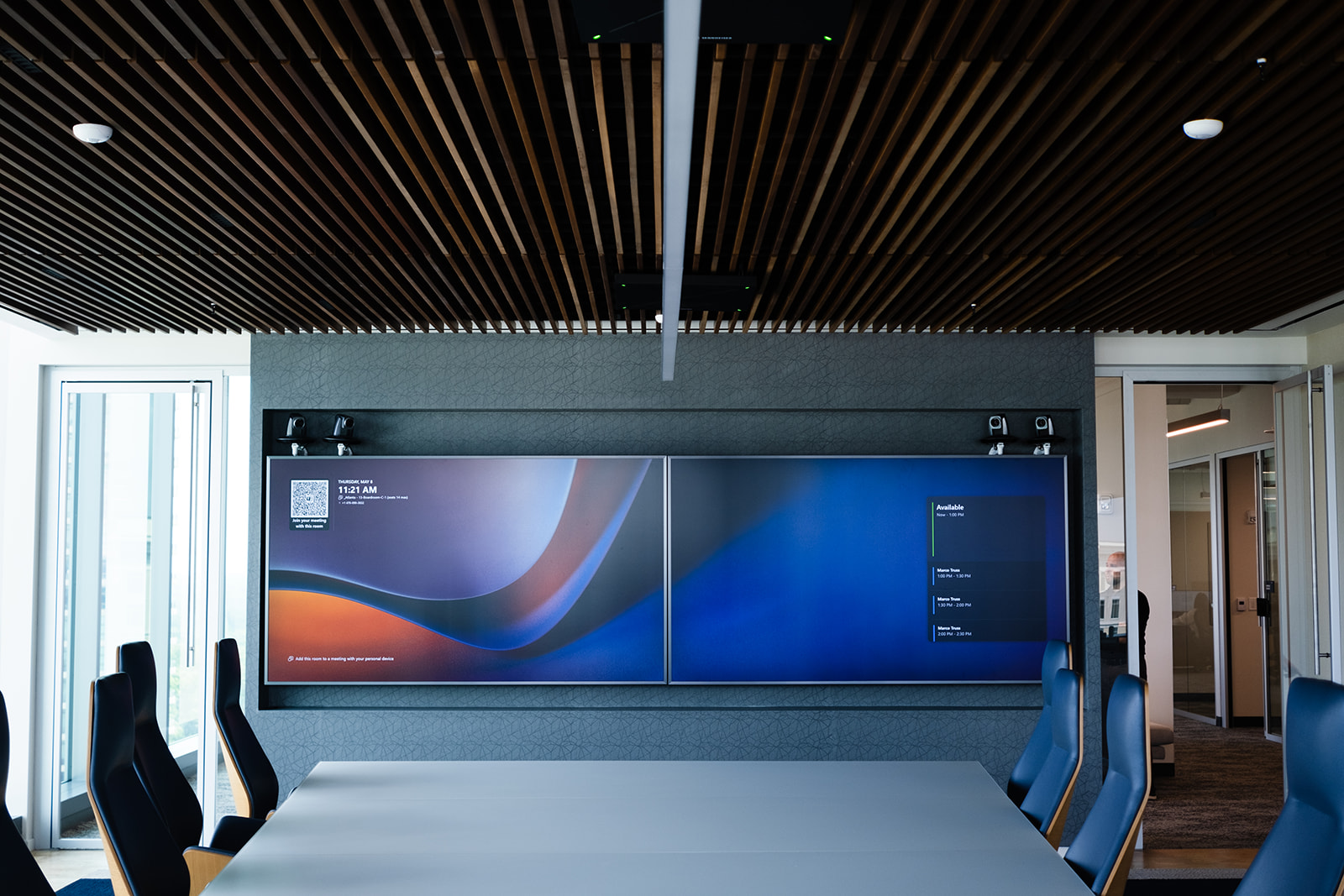
An integrator’s view from inside the rooms where the real work happens.
Enterprises are not consolidating unified communications platforms because it’s trendy. They are consolidating because the operational cost of fragmentation has finally become impossible to ignore.
For years, IT teams stitched together voice, video, messaging, and content sharing using whatever tools were available at the time. A phone system here. A conferencing platform there. A chat app running alongside both. Each room became its own ecosystem — its own drivers, its own quirks, its own troubleshooting path.
That patchwork worked well enough when hybrid work was optional. It does not work in a world where meeting rooms are mission‑critical infrastructure.
Consolidation is not about software licensing. It is about room behavior, supportability, governance, and scale, the things that determine whether an enterprise can operate predictably.
Below are the five reasons enterprises are making the shift, written from the perspective of the people who design, deploy, and support the rooms where these decisions become real.
Reason 1: Fragmentation Creates Operational Drag — One Platform Removes It
Every additional platform that an enterprise deploys introduces its own identity integration, update cycle, support queue, and failure modes. Five platforms do not create five times the complexity, they create exponential complexity.
Multiple platforms mean multiple calendar behaviors, audio/video state machines, control interfaces, escalation paths, and multiple “it works in this room but not that one” inconsistencies.
Consolidating onto one platform collapses that surface area. The IT team troubleshoots one system instead of five. Support load drops. Mean Time to Resolve shortens, and the organization stops losing hours diagnosing which tool broke this time.
This is not a licensing benefit, it is operational stability.
Reason 2: Consistent Rooms Create Predictable Meetings
Employees move between rooms expecting them to behave the same way. Fragmented platforms guarantee that this will not be their experience.
When every room is built around a different tool, or the same tool configured differently, people spend the first minutes of every meeting relearning the interface instead of focusing on the meeting objectives.
A single unified communications platform allows AV teams to standardize camera behavior, microphone logic, display routing, control panel workflows, calendar integration, and join‑flow behavior.
Predictability is the real value. Meetings start on time because the room behaves the same way every time in every room.
Reason 3: Governance, Identity, and Security Become Manageable Again
Every additional communications platform is another identity provider, another access policy, another audit surface, and another set of logs security teams must monitor.
Fragmentation creates blind spots and confusion. Consolidation eliminates them.
One platform means, one identity integration, one access control model, one audit trail, one patching cycle, and one compliance posture.
Security teams do not need five dashboards to understand what is happening across the enterprise. They need one, and they need to cover everything.
Reason 4: Vendor Sprawl Distracts Leadership — Consolidation Refocuses It
Running multiple communications platforms means multiple contracts, renewal cycles, support relationships, SLAs, and multiple vendors pointing at each other when something breaks. Leadership ends up managing vendors instead of managing outcomes.
Consolidation collapses that overhead. One contract. One renewal. One support relationship. One escalation path. This isn’t just cleaner procurement, it’s cleaner accountability.
Reason 5: Standardization at Scale Becomes Possible
Enterprises do not build one room. They build dozens, hundreds, sometimes thousands. Fragmented platforms force every room to be a custom project. Different drivers. Different hardware. Different control logic. Different integration patterns.
A unified communications platform makes standardization realistic: A single design pattern, hardware ecosystem, integration standard, deployment playbook, and a single monitoring strategy.
This is how enterprises scale without reinventing the room every time.
What to Evaluate Before You Consolidate
Consolidation is not a software decision; it’s a room decision. Before committing to a platform, evaluate the following:
- Hardware compatibility. Will existing cameras, microphones, DSPs, and control systems work with the new platform?
- Migration path. Can rooms move in phases, or does the platform require a hard cutover?
- Integration standards. Does the platform vendor’s certified hardware list align with AV system design for hybrid work already in place across your real estate footprint?
- Lifecycle cost. How does per‑room licensing compare to the combined cost of the tools it replaces?
- Change management. How quickly will the workforce adopt the new workflow?
Frequently Asked Questions
Unified communications describes the capability: voice, video, messaging, and content sharing in one system. UCaaS delivers that capability as a cloud service instead of on‑premises infrastructure.
Through certified hardware ecosystems: cameras, microphones, DSPs, and control systems built to work with the platform’s software layer. The quality of the room design determines whether that integration feels seamless or fragile.
Hardware compatibility, migration timeline, integration standards, lifecycle cost, and workforce adoption.
Consolidation reduces the number of failure modes support teams must diagnose. Instead of troubleshooting five platforms with five different escalation paths, support teams focus on one predictable workflow, which shortens MTTR and reduces ticket volume.
Treat Consolidation as a Room Project, Not Just a Software Purchase
On paper, choosing a unified communications platform is a software decision. In practice, it determines how every room in the enterprise behaves for years. Enterprises that treat consolidation as a procurement exercise often end up with a platform that works and rooms that do not. The integrator’s role is to bridge that gap: to design rooms that behave predictably, supportably, and consistently across every site. If consolidation is on your roadmap, start in the rooms. That is where the real impact and where the real value shows up.